The detailed instructions concerning the various sacrifices has God looking a bit OCD.
The laws concerning skin diseases, mildew, and “discharges” has Him looking like a germ-o-phob.
And then there is chapter 18 from today’s reading. Once again… really? They had to be told this stuff? Baffling.
So what is going on? There is tons one could say, but suffice it to say, “Leviticus is all about God’s holiness.” It is stated outright in 11:44-45, and underscored by nearly every other verse in the book. Everything about the book is saying that God is set apart. Different. Not common.
Even the chapters that seem to be about God’s “health plan” for the Israelites are really about contamination. On the surface, it is about physical contamination. But just below the surface is the idea of spiritual contamination as well.
How about all the sexual taboos? They are preceded by injunctions against doing what people do in Egypt or in Canaan. This too is all about “set-apart-ness”.
“Be holy, because I am holy.”
God is distinct, different from anything else in their experience. They too are meant to be distinct and different.
It’s strange how the Christian calendar has grown in significance for me over the past several years. I don’t remember when I was first introduced to the idea of Lent, but something about it resonated with me from my initial experience with it. I’ll be talking more about that in the next week or so.
However, with Ash Wednesday (the beginning of Lent) just a couple weeks away, I wanted to make you aware of some resources that can help focus your heart, mind, and soul during the forty-six days leading up to Easter.
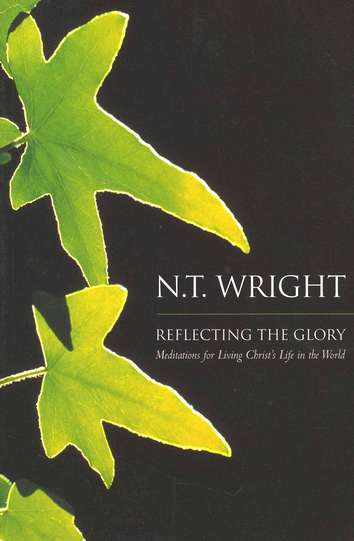
Last year, I used this great book by (of course) my man N. T.
Over Christmas, my beloved bought me Bread and Wine: Readings for Lent. It is a collection of readings by various authors who in turn speak to the truths that are prominent during the Lenten season. The line up is impressive… Kathleen Norris, Thomas a Kempis, Bonhoeffer, Kierkegaard, Kahil Gibran, Jurgen Moltmann, Wendel Berry, Mother Teresa, to name a few. Knowing that I’ll be “sitting down” with these folks during the days leading up to Easter has helped me to look forward to it all the more.
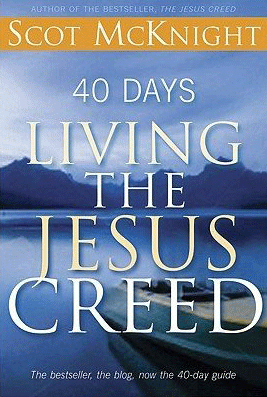
I was also recently made aware of another book that isn’t necessarily a Lent reading, but since it follows a popular “40-day” format, it will certainly fit for the season.
I realize that several of us already have a bit of a reading project going on, but I like to think that there is always a little more time for reading.
I think I’ve mentioned N.T. Wright once or a thousand times. Let me recommend taking some time this week to listen to a couple lectures he gave a few years back at Calvin College on “Space, Time, Matter and the Sacraments.”
I realize that it may not sound like the most exciting topic, but here are a few reasons to push through and do it anyway.
1) He is one of the most influential New Testament scholars alive today, and it would do any Christian some good to know a bit about him and his work. I don’t necessarily agree with every single thing he says, but listening to him will help you better understand me. Which I know is everyone’s ultimate goal in life.
2) He walks through lots of the Bible and without really meaning to shows how much of it holds together. I think those of you doing the Cover-to-Cover will benefit from having something of an overview of this strand of biblical theology.
3) Most protestants don’t have a robust enough understanding of the Sacraments (particularly Baptism and Eucharist), and these two hours of lectures will move one in the right direction.
4) There is something in here for everyone. Really. Not just Bible nerds, but also poets, dancers, new mothers, C.S. Lewis fans, and of course, Christians in general. However, in order to benefit from the few words he may have for these specific interests, one has to wade through all the “God-talk.” Which is of course the way it should be.
I was going to wait until next week, but seeing as we’ve just wrapped up Exodus, maybe now is the time to talk about it.
What’s the point of chapters 36-39? Why does Exodus’ author feel the need to repeat nearly every word from 25-28? Wouldn’t it have been enough to simply say “The Israelites had done all the work just as the LORD had commanded Moses” (Exodus 39:42)?
Bear in mind that whatever writing materials they might have used (tablets or papyrus/parchment) would have been costly and so each words counts. Why not a little more detail back in Genesis on Jacob wrestling God? Or some more explanation of Abraham’s near sacrifice/murder of Isaac?
Instead, we have a painstaking account of Israel meticulously constructing the Tabernacle in a way that exactly corresponds to the instructions God had given them. And I suppose that’s the point. Moses (or whoever wrote it) wanted future generations to understand that God’s instruction is not something to be spurned lightly.
We live in a religious culture that goes to great lengths to emphasize it isn’t what you do in relation to God that matters, but how you feel about God. As long as our hearts are right, then all the external stuff called religion really isn’t of consequence. In fact, it may be detrimental. I’m not sure we can read too much into this, but my guess is that the Israelites felt that God needed to be heeded… even in the details.
Ok, so here we are four weeks in, and I’m guessing no one is loving me too much for the Cover-to-Cover challenge. What sounded so well-intentioned, pious, and worth-while on the front-end is starting too lose its luster in a hurry.
If you are on track, you will have read through Exodus 36 today. Not the most inspirational reading by anyone’s reckoning. It would be the exceedingly rare person who finds the detailed instructions for building the Tabernacle inspiring. More on this next week.
However, I think a word or two is in order concerning the ‘miscellaneous’ laws or what is sometimes known as ‘civil’ law. I know that it seems like God is actively promoting retribution, but you should know that God isn’t trying to institute some detailed process for revenge. These laws are actually meant to curtail an excess of revenge.
So for example for when it says things like, “an eye for an eye, a tooth for a tooth,” while gruesome sounding to our ears, could be read, “an eye and no more.” You can’t kill someone for knocking out your tooth. All you are entitled to is an equal measure of retribution. Same goes for bulls goring and accidental deaths and so on. The Law says, “you may be entitled life for life, but you can’t out of revenge kill off the offender’s entire family.” Societies both ancient and modern left to their own tend towards barbarism. It is the Judeo-Christian tradition that steers people towards more humane ways of being human.
Another example of humanity’s drift towards sub-human existence is the commandment that says, “Anyone who has sexual relations with an animal must be put to death.” Now apart from getting the middle-schoolers at church giggling, what purpose does this verse serve? Does it seem as strange to you as it does to me that people need to be told that sex with animals is a departure from God’s plan for human sexuality? Was it a widespread problem at the time?
Who knows. The point is they had to be told… Don’t do this. This is wrong. Again, society left to its own will sink to the lowest levels of human depravity. It is God, his Word, and ultimately his Spirit that elevates human beings to their role as image-bearers of God.
Not really knowing what to say about the tragedy taking place in Haiti, I’ve made the mistake of saying nothing.
Part of my silence is born out of the recognition that anything I might say wouldn’t do justice to the magnitude of loss and suffering taking place there. As if to put words to it would take something immensely catastrophic and make it less than that.
That said, a very few things could and should be said. So with an economy of words, here goes.
Pray – A short video here might help us get barely in touch with the suffering taking place there.
Also, World Vision UK has issued a call to pray for forty days on behalf of the Haitian people…
Give – Two worthy relief organizations that the Chino’s love are:
Go – I am hearing stories of individuals and churches who are doing what needs to be done in going down and being the hands and feet of Christ. Those stories are as good as they are humbling.
“For I was hungry and you gave me something to eat, I was thirsty and you gave me something to drink, I was a stranger and you invited me in, I needed clothes and you clothed me, I was sick and you looked after me, I was in prison and you came to visit me.”
It is no secret to those who know me that I’m organizationally challenged to say the very least. I’ve long since accepted it as an unfortunate attribute and have decided to live with it. And yet, like you, I process an avalanche of information on any given day. So how can a person be expected to stay on top of the stuff he or she is expected to stay on top of?
I am a compulsive list maker, which might lead you to believe that I’m something approaching administrative. You would be wrong. No, my lists are born out of a nagging fear that I’m going to forget something that I’m suppose to get done. Even with all my lists, I still manage to let a bunch of stuff slip. Right this second, as I write this post, I’m letting slip the reason I started typing in the first place. Which was to share a few valuable (at least, in my opinion) resources to manage information.
1) An RSS Aggregator – This goes by various names I think – RSS Reader, Feed Reader, Blog Reader, etc… But the idea is simple. If you keep up with several blogs (or anything that uses RSS feeds), this thing collects them all in one place. So you don’t have to go visit the sites you like on a daily or weekly basis to see if new stuff is there. It “checks” it for you.
I realize that since you are reading a blog right now that you probably already know about these. But you may not, and if you follow more than two blogs, you should get going on this. I use Google Reader. It does what it is suppose to do and does it well.
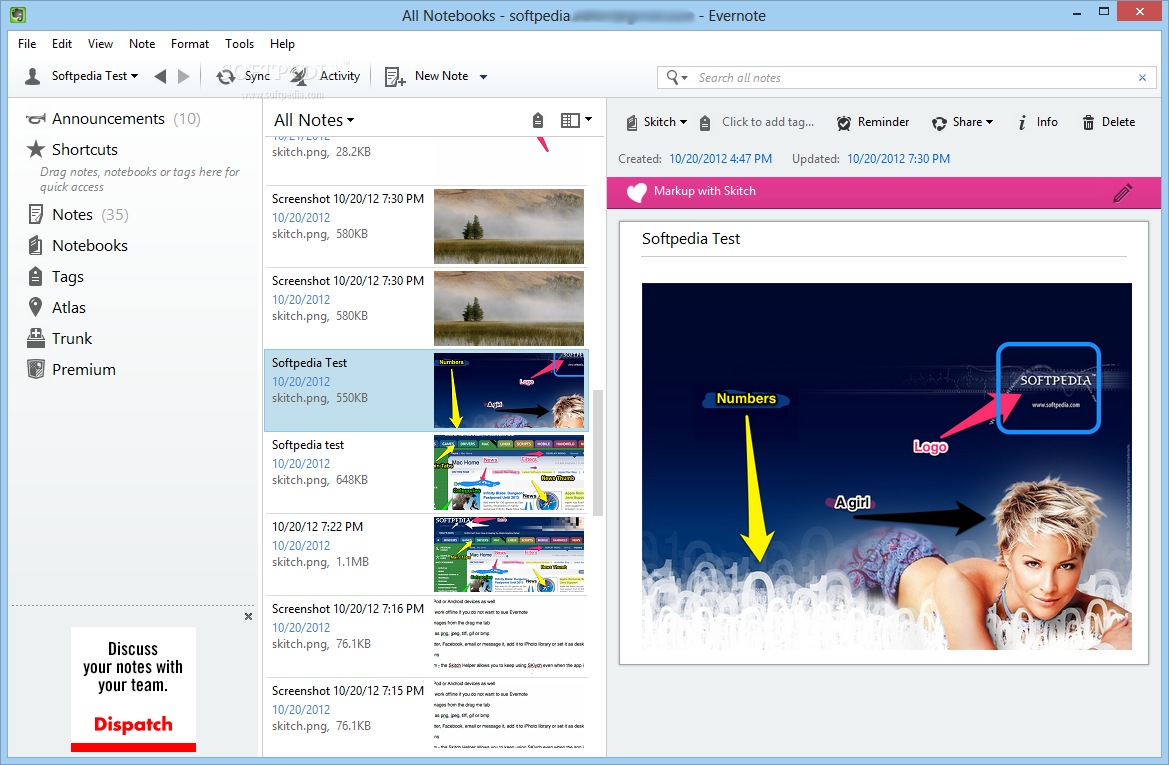
2) Evernote– This is the ultimate electronic information keeper. To do lists. Projects. Ideas. Movies to see. Books to read. Articles or website you find online. Anything that you might be tempted to scribble down on a piece of paper.
The real beauty of this is that you can access it a ton of different ways. There is software that you can install on your computer. There is a web-interface. There is even an iPhone app. And each device is constantly keeping in sync with all the others. So… my home computer, work computer, and phone all have the same info going.
Also, if you collaborate with people on projects, you can easily share information with other Evernote users. But my favorite means to collaborate is Google Docs. Google Wave promises to be even better, but I haven’t really looked that closely at it.
3) Zotero – This is primarily a research tool, but I think it is for anyone who reads lots and wants to keep notes, quotes, annotate the books they read.
It is a Firefox add-on, but it also syncs stuff to online servers so that if you have it installed on multiple computers… well, I think you are starting to get the idea.
Ok, so there’s plenty of overlap with some of these tools, but hopefully it will help slow the continual leaking of things I used to know.
A friend of mine just sent this my way. I saw it over the holidays, but I’ve just been reminded how good these were. They are all great, but if you only have time for one, go with the first one. Happy Friday!!!
I’m not really sure how many people are doing the Cover-to-Cover thing this year, but my guess is a bunch. Alison is. Both small groups I’m involved in are doing it. A bunch of my co-workers. I run into people at restaurants and grocery stores telling me they are on track. Which is all good and well, but that leaves me feeling a little responsible for this being a good experience for them.
I know that I shouldn’t feel that way. This is God’s Word and we tell ourselves all the time that a person can just sit down and read the Bible and God will use it for good in their lives. But what if he doesn’t? Or worse, what if instead of drawing people to Him, it pushes them away? It wouldn’t be the first time that a person was put off by the way God is revealed in the Old Testament.
This week, we’ve been reading in Exodus. And on the surface, it can seem like God is being arbitrary, capricious, fickle, mean. Why was God “about to kill” Moses in Exodus 4? Why is God the one who hardens Pharaoh’s heart? Why was it necessary to kill all the firstborn in Egypt?
I don’t come with any answers today. But all this highlights that there is much in the Bible that is strange and foreign to us. Which for me raises the question… how much of that foreignness is due to being fallen and finite human beings unable to have God’s heart and mind or His much larger perspective on things? And how much of the foreignness is a result of our being so far removed culturally from the time and place in which these things transpired? As with most things Bible, my guess is both.
No blog post is going to make either of these massively complicated issues go away, but let me make one small suggestion.
Get help.
I know that the penultimate portrait of the ideal Christian is a person all alone with their Bible receiving what they need to understand “directly” from God. But as I have (with very little success) tried to explore in previous posts, it is never just me and my Bible. There is always a certain set of assumptions, and previous experiences, and cultural worldviews, and personal biases, and relational dynamics, and so on that guide our reading.
So you need others to help. And while doing it with a group of people is good, if they are all share the same limitations of expertise and background then you’ll probably end up doing what I do… stare at each other with blank looks and say, “maybe.”
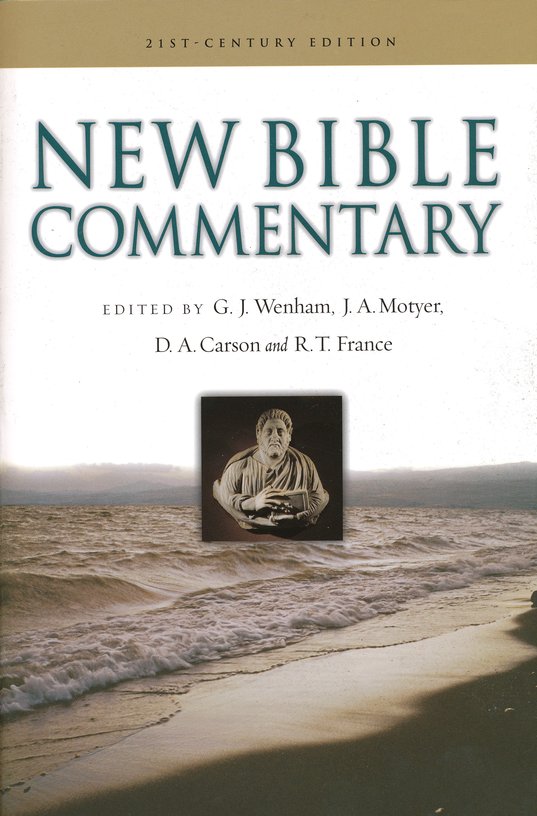
Someone who is doing the read along came across this one-volume commentary and wondered if I would recommend it.
I would. What you get is a commentary on the entire Bible in one book by some guys who ain’t dumb. So when you read that Moses was about to die until quick witted Zipporah did what needed to be done (with a knife and no anesthetic – yikes), it might tell you something like this episode needs to be read in the context of the verses prior where God predicts Pharaoh’s refusal to obey God. And refusal to obey God whether you are Pharaoh or Moses (or you and me) has serious consequences. Something like that.