Deep Church 3

Brazos – Day Glo

I hope you appreciated Belcher’s comments on unity and new ecumenism as much as I did.  He repeatedly referenced this idea of the “unity of the Gospel,” which he says is embodied in the classic Christian Creeds.  Of course, not being familiar with the Creeds could pose something of a problem for us.  While I have yet to memorize even the shortest of them, there have been times when I was more familiar with them than I am right now.  Reading over them again, I was reminded of few things.

First, they are simple.  With the possible exception of the Athanasian Creed (I’ll get to its strengths in a minute), they say what they need to say and no more.  They don’t get bogged down in side issues, which of course is the point – both of the Creeds and Belcher’s praise of them.  They deal with what are “core” beliefs of the faith.

Second, they are clear.  There is very little ambiguity in them.  While I was somewhat amused by repetitiveness of the Athanasian Creed, you have to admit…  it is painstakingly clear.

But third, and perhaps most striking, they are radically Trinitarian.  Really, the subject of another post entirely, but it is interesting that the early Christian Fathers put such an emphasis on this biblical truth.  Lose sight of the complexity and mystery of the Trinity, and everything begins to unravel.

Ok, there’s my two-bits.  How about you?  Do you see a “new ecumenism” taking shape?  Is it one that you see as defined by this two-tier idea of inclusive commitment to the “top tier” truths?  What role do creedal confessions play in the church today?  What is your favorite creed?  Favorite ice cream flavor?  Favorite Thanksgiving food?

Word Pictures

The Swell Season – Star Star

A little while back, I read Word Pictures: Knowing God Through Story and Imagination by Brian Godawa.  Don’t let the cover or the title fool you.  On first impressions, one might be led to believe that it is artsy-heavy and theology-lite.  The author’s involvement in the movie industry might also (mis)lead one to believe that as well.

It ain’t.  He is up on his theology and does a masterful job synthesizing a wealth of biblical, cultural, and historical information.  Of course, as with any book there are shortcomings, and I would welcome the opportunity (as unlikely as it seems) to clarify some points with him.  Nonetheless, his main point is taken well enough.  The modern church has relied too heavily on propositional truth as enshrined in systematic theologies and the like, and not enough on story, narrative, imagery, and icon.

While you can head HERE to read the first chapter, this quote should give the flavor of the book…

“The net effect of this virtual ignoring of the theological value of art is the implicit devaluing of it.  As the saying goes, actions speak louder than words, and a systematic theology without a developed aesthetic is an implicit sign of an underlying belief that beauty is not an essential part of theology.”

So again, while there are times when he overstates his case and fails to take certain factors into account, I am in general agreement that we stand to lose much when the arts (in their manifold expression) are ignored.  This book is for anyone who loves the arts, the Word, and fairly weighty theology.

Deep Church 2

One of the things this chapter does well is identifying the concerns associated with the “emerging” church.  So which (if any) of the protests are ones that you share as well?

Just so you don’t have to go back and look them up, here they are again…

1) Captivity to Enlightenment Rationalism
2) A narrow view of salvation
3) Belief before belonging
4) Uncontextualized worship
5) Ineffective preaching
6) Weak ecclessiology
7) Tribalism

Ok, even as I type, I am recognizing that some of this sounds fairly esoteric.  Let’s try to flesh it out.

in your place

For several years now, my understanding of “place” has been developing.  That is to say, where we live, work, worship, and play matters.  My thinking on this is still relatively scattered, and I’ll share some auto-biographical comments in this post.  But my thoughts were stirred again when I came across this article.  It is a little dense, but it should appeal to the poet, farmer, and theologian alike.  I’m not suggesting that those are mutually exclusive categories either.  Most theology would likely be improved by a healthy dose of poetry…  and farming.  I digress.  Read the article.  You won’t might not be sorry.

I was also reminded of a friend in Seattle who is pushing on this question in a highly rigorous fashion, albeit from a somewhat different angle.  In fact, it was living in Seattle that the wheels first began to turn on this.  Alison and I were living in a suburb some twenty minutes (over thirty in traffic) away from work and worship.  I realize that in today’s society, traveling long distances to do either of those activities (and a host of others) isn’t uncommon.  But the thought was firmly lodged in my mind…  there is something different about actually being in a community.  “In” being more than just a preposition of location, but carrying the full significance of all that “in” possibly can.  “In” in the sense of “fully invested in.”

So when we moved from Seattle to here, living in close proximity to the place I would work and we would worship (which for me happen to be the same place) was a high value for Alison and me.  Even the choice for where our children would go to school was driven largely by the same conviction.  It is right across the street from the church, and while it isn’t “the” school, it is the school in the community to which we felt called to sink roots.  So we bought a house that is within walking distance from all the above.

I couldn’t be more grateful that we were led/compelled to choose this home.  The house itself is nothing special, but as they say in business – “location is everything.”  We could have built a life in nearly any home in our city, but we have done so here.  This few block radius is by and large where life happens for us, and so there is a deep sense of connectedness to our (holy?) place.  Our home is centrally located in the city, which means it is highly accessible for friends and family and on the way to anywhere they might be going.  It is affordable, simple, warm, and sufficient.  It truly is and has been God’s provision for us.

I’m not saying that this is the house we’ll live in for the rest of our lives.  There are numerous reasons for considering moving… where our children attend school is starting to spread geographically, our family has grown – not just numerically – but in the sheer volume they take up, not to mention my on-going fascination with forming an intentional-missional-community.  But every time the question of moving comes up, we always end up responding…  “Why would we want to move from here?  This is our place.”  With an appropriate stress on each word of that sentence.

When you have eaten and are satisfied,
praise the LORD your God for the good land he has given you.

Deuteronomy 8:10

(grossly out of context, but there is some truth for us in there.)

Deep Church 1

Ok, so here we go.  I’m going to throw out several questions that came to mind as I was reading the introduction and first chapter. Feel free to answer any, all, none, others, or ask entirely different questions.

In the Introduction, Belcher paints a picture of the rift that has and opened between the “Traditional” and “Emergent” church.

How aware are you of this growing division?
Would you identify yourself as leaning more traditional or more emerging?
How have you been affected (if at all) by the in-fighting?
Do you think Belcher’s broad strokes paint a fair picture of the current state of evangelicalism? Would you describe it any differently?

In chapter 1, Belcher briefly recounts his own story and relationship with the church.

How has your history with church influenced where you find yourself in relation to these two poles within (North American Evangelical) Christianity today?

Belcher describes a strange sense of being both an insider in the emerging movement and yet at times feeling alienated from (an “outsider’) as well.

Can you identify in any way with that “insider”/”outsider” feeling as it relates to church?

Deep Church… Almost

Ok, so I think about a dozen people or so are committed to reading this book together.  We are shooting for having our first “discussion” next Monday (11/16).  Just in case, you haven’t gotten your hands on the book yet, and can’t wait to dive in, here’s a LINK to the intro and first chapter.

Once again, I hope that there isn’t uniform agreement among all of us reading.  I’m not one who likes to argue just for the sake of arguing (despite what my beloved might say), but it will be sort of boring if we are all just nodding our heads ‘yes’ from week to week.  But on the flip side, I think it goes without saying, that we should strive to respect each others’ opinions (including the author’s).  Sometimes electronic discourse creates an environment in which people say things that they might not normally if they were face to face with a person.   Ok, you get it.

Read with me?

Ok, so I thought I’d try something different around here.  Instead of me telling you what I am reading or have read lately, I thought it might be interesting to read something together.  An online book club if you will.  Here’s how it would work.

Step 1: Give everyone a chance to acquire the book.

Step 2: Establish some reasonable reading schedule.  Maybe a chapter each week.

Step 3: Begin reading it.

Step 4: Weekly post some thoughts, questions, or reflections from the chapter.

Step 5: And here’s the all important part…  Everyone reading the book joins in the online conversation.

Simple enough.  So the book I had in mind is Deep Church by Jim Belcher.  I’ll be honest, I know next to nothing about the book.

I like the front cover.  I read the back cover.  It is endorsed by people who I am drawn to…  and some that I’m not.  But I know that the author (or publisher) is speaking my language when he says,

“Deep church looks like – a missional church committed to both tradition and culture, valuing innovation in worship, arts and community but also creeds and confessions.”

My hope isn’t so much that we’ll all be convinced that his perspective is the “right” one.  Rather, I’m hoping that through reading this book together we’ll begin to ask some of the right sorts of questions concerning what it means to faithfully live out our calling as the people of God today.

So if it looks interesting to you, and you would like a place to think out loud about what you are reading and thinking, then pick up a copy and we’ll get started in a couple weeks.  If you are local and want me to order a copy for you, let me know by November 2nd.

I’ll shoot for having the first post up on November 16th.

If you aren’t feeling the whole “emerging-church-dialogue” thing, then I’m also reading THIS and THAT.  I’d be happy to talk about them too.

Surprised By Hope… Again.

Mumford and Sons – Roll Away Your Stone

I take it back.  In my little blurb on this book a few posts back, I suggested that this wouldn’t be a very good introduction to N. T. Wright’s thinking.  I was wrong.  It may be the perfect book for that purpose.  I read a bit and thought that it was going to be a toned down version of his exceptionally long treatment life after death and the Christian understanding of resurrection.  It is that, but so much more.
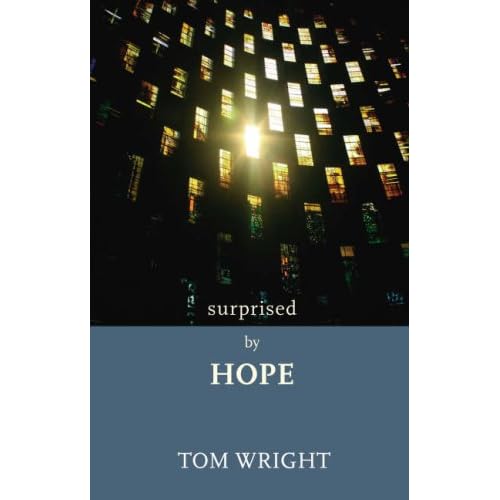
Who should read this book?  Anyone who cares about understanding what the New Testament teaches about life after death.  I think even the relatively informed Christian will have their thinking on this subject clarified.  Anyone who wants to understand the gospel and salvation better.  Anyone who wants to understand the mission of the church more fully in terms of the resurrection.  Anyone who tires of simplistic reductions of the Christian faith that tend to rely more on categories of Greek philosophy than the story that emerges from the pages of Scripture.

Here are a few gems…

[A] feature of many communities both in the postindustrial West and many of the poorer parts of the world is ugliness.  True, some communities manage to sustain levels of art and music, often rooted in folk culture, which bring a richness even to the most poverty-stricken areas.  But the shoulder-shrugging, functionalism of postwar architecture, coupled with the passivity born of decades of television, has meant that for many people the world appears to offer little but bleak urban landscapes, on the one hand, and tawdry entertainment, on the other.  And when people cease to be surrounded by beauty, they cease to hope.  They internalize the message of their eyes and ears, the message that whispers that they are not worth very much, that they are in effect less than fully human.

Ok, after you have wrapped your brain around that one, here’s another…

The power of the gospel lies not in the offer of a new spirituality or religious experience, not in the threat of hellfire (certainly not in the threat of being “left behind”), which can be removed if only the hearer checks this box, says this prayer, raises a hand, or whatever, but in the powerful announcement that God is God, that Jesus is Lord, that the powers of evil have been defeated, that God’s new world has begun.

Or…

As far as I can see, the major task that faces us in our generation, corresponding to the issue of slavery two centuries ago, is that of the massive economic imbalance of the world, whose major symptom is the ridiculous and unpayable Third World debt … I simply want to record my conviction that this is the number one moral issue of our day.  Sex matters enormously, but global injustice matters far, far more.

But in order to understand the context of statements like these, one needs to wade through ones like this…

It is love that believes the resurrection.  “Simon, son of John,” says Jesus, “do you love me?”  There is a whole world in that question, a world of personal invitation and challenge, of the remaking of a human being after disloyalty and disaster, of the refashioning of epistemology itself, the question of how we know things, to correspond to the new ontology, the question of what reality consists of.

I think I’ve said this before, but there is no one writing today who more clearly expresses my own feelings, thoughts, misgivings, and hopes.  While he begins with developing our understanding of the resurrection, he ends up leaving no stone unturned.  Because he (and I) believe just that…  the resurrection changes everything.


better words

Tonight, I was engaged in one of my main roles as a pastor… teaching.  And it wasn’t on any ordinary run-of-the-mill topic either.  It was on the rather thorny issue of “How can a good all-powerful God exist when there is so much evil and suffering in the world?”  Envying me yet?

Frequently after teaching, I will come across someone who says in writing the same thing I say – but better. Rarely though does that discovery come so quickly. So, not two hours later, I read from N. T. Wright’s Surprised by Hope the following:

If creation was a work of love, it must have involved the creation of something other than God.  That same love then allows creation to be itself, sustaining it in providence and wisdom but not overpowering it.  Logic cannot comprehend love; so much the worse for logic.

Yeah, what he said.