Four (to see/hear) for Friday

Little Rock’s live music scene is just about right for me. Certainly, most of the bands and musicians I enjoy don’t find their way to Central Arkansas, but that is probably a good thing. I really don’t have the time or money to go see some live music once or twice a week. As it stands, I probably end up seeing about half a dozen or so shows a year.

That being said, this fall, Little Rock will be graced with the musical talent of no less than four artists that receive my stamp of approval. It is rare that everything works out for me to actually make it to these shows, but if any of you are interested, I might make a special effort.

Blind Pilot – Keep You Right / October 8th – Stickyz / Saw these folks a couple years ago in Chicago. Really great. Brand new song off an album being released soon. This is a can’t miss show.

Mutemath – Odd Soul / October 11th – Rev Room / These guys are some pretty creative dudes. Need proof? Head over HERE and see how they have put the wonderful world of the internets to use.

Generationals – Ten-Twenty-Ten / October 30th – Rev Room / They are appearing with Mates of State, which ain’t so bad either.

AA Bondy – The Heart Is Willing / November 11th – Stickyz / A perennial favorite is back again. This new track is a bit darker than some of his previous work. But no matter, I’m still looking forward to going.

BONUS…

Ben Rector – Autumn / October 26th – Juanita’s / All my college friends are nuts about this guy. I like him too. He has a new album out that you can DOWNLOAD for whatever amount you would like to donate… even free.

Happy Friday!

Four (More Daytrotters) for Friday

A while ago, I mentioned this great music site. If I only had one source for music greatness, this would be it for all kinds of reasons.

But instead going into all that, I’ll just share four artists I really like who have done sessions with Daytrotter recently.

Andrew Belle – The Ladder (Daytrotter Session)

Seyrn – River Song (Daytrotter Session)

The Head and The Heart – Sounds Like Hallelujah (Daytrotter Session)

James Vincent McMorrow – Follow You Down to the Red Oak Tree (Daytrotter Session)

Later.

A Wealth of Wisdom

Ok, I know that I should be getting back to my series of posts on Luke. I have things I would definitely like to say. However, I recently came a across some videos that I found helpful for all kinds of reasons. Three men (sadly, all white) that I have tons of respect for were in something of a round table discussion talking about things that I think are important. Their conversation is worth listening in on.

The men are…

Don Carson (one of my professors of NT at Trinity Evangelical Divinity School)

John Piper (influential pastor/scholar/author at Bethlehem Baptist Church in Minneapolis, MN)

Tim Kelller (like Piper, pastor/scholar/author at Redeemer Presbyterian Church in New York City, NY)

You likely won’t know this about these men, but they are cut from similar “Reformed” cloth. While I am a closet Calvinist, I’m not as committed to it as these guys. Which means that I don’t buy into every single thing these guys are selling (big surprise there). Yet by virtue of their decades of God-seeking experience alone, their wisdom should not be easily dismissed.

  • Watch this if you have ever wondered how senior leaders should transition their leadership roles to the next generation.
  • The next three are on the Bible and how one ought to engage it, respect it, and apply it.

  • This last video is about what has made their marriages (and mine) work. 

Enjoy.

Four (from the 80’s) for Friday

Last Saturday evening, I had the privilege of seeing some talented students perform in The Rep’s Summer Musical Theater Intensive (SMTI). This year’s production is “That 80’s Show: We Built This Smitty on Rock and Roll.” It wasn’t until the lights dimmed and things were underway that I realized just how deep the imprint this decade has left on my life. I hate to admit it, but there wasn’t a song performed that I didn’t know every single lyric. Sad, I know. So in honor of this penultimate decade of musical genius, four drum-machined and synth-ed songs for your listening pleasure. By the way, they are reprising the production in the fall. If you ever had parachute pants, leg warmers, Member’s Only jackets, highly teased bangs, or God forbid – a mullet, this is a show for you us.

In fact, let’s do this… how about we play a little game of name that tune. I’ll leave all the song info blank, and you can tell me if you know title and artist. Don’t strain yourself.

You should probably stripped of all music listening privileges for life if you don’t know this one.

Four (Weeks) for Friday

It has been a month to the day since my last post. Just over four weeks. And since it is Friday… well you’ve read the title. Here is what’s been up with me over the last four weeks.

Week 1 // KAA – Fortunately, my pardner in crime has done a pretty extensive write-up of the week. So, I’ll leave you with a song and a picture.

Tedashii – Dum Dum (feat. Lecrae)

That’s Lauren Foster (one of our 9th grade students) about to launch herself from the top of a thirty-foot telephone pole. This photograph is a snap-shot of what the whole week was about… risk, facing fears, trust, and leaps of faith.

Week 2 // The family loads up and heads west. It is no secret that I love the mountains and that they regularly provide the backdrop for our family’s adventures. Alison has shared some here.

Josh Garrels – Pilot Me

Week 3 // We are joined by more family and friends and bikes… and games. There was easily a game of Settlers a day. Many days, more than one.

Leagues – Mind Games

Hiking to Judd Falls

Taking “5”

One of the “floats” at the 4th Parade

Week 4 // The infamous Senior Backpacking Trip.

Mumford & Sons – Home (possible title live)

This one started off this way…

and ended like this…

It has been a very good four weeks.

The Gospel of Luke 4:1-44

Luke 4:1-44

I’ve recently written a few comments and spoken some on Luke 4, so I don’t feel the need to rehearse all that I’ve already said. But for the sake of clarity, let me say at least one thing again… Luke 4 is less about giving us instructions on how to deal with temptation, and way more about who this Jesus is.

One thing that I didn’t mention either in the message, nor very explicitly in the earlier post, is that Israel is sometimes spoken of as being God’s son (Hosea 11:1, Exodus 4:22, possibly Psalm 2:7). One might argue that connecting Jesus’ sonship to the sonship of Israel somehow lessens its force as it relates to our understanding of Jesus’ divinity. That is to say that when Israel was called “God’s son,” no one made the mistake of thinking Israel was divine. Why take the son language about Jesus to do so?

In response, I would argue that the connection between “Son of God” language used for Israel and Jesus doesn’t lessen our understanding of who Jesus is. Rather, it is enhanced. The remainder of the New Testament makes clear that Jesus’ is the Son of God in a way that no one ever has been or could be again. Jesus’ relationship with God the Father is unique. In fact, one can say fairly confidently that the point of Luke 4:1-13 is to say precisely that! Jesus is God’s son in a way that Israel never could be.

But Luke 4 probably isn’t speaking into the Jewish world only. As Luke’s gospel is taking shape, there are others in the Roman world that would make a rival claim to being the “son of God” and divinity. Various Roman emperors would refer to themselves in those terms, and require others to do the  same. So it may well be that Luke is simultaneously addressing the Jewish and pagan worldviews of his day.

In essence, the message Luke is putting across in these first few chapters is “Jesus is God’s one and only true son.”

The Gospel of Luke 3:1-38

Luke 3:1-38

We’ve switched back to John’s part of the story, and we find him in the Judean wilderness – the countryside around the Jordan River. This doesn’t just give us information about where he is, but also where he isn’t. This renewal movement isn’t happening in the religious and political (not easily separated) center of the nation, but away from it.

Furthermore, he is tapping into a long held hope of the Jewish people that God might manifest himself by returning to be with them and restore them. This preparation to which John is calling his country men and women is one of repentance and ritual cleansing. A few things in particular stand out about his call to repentance… 1) There is a sense of urgency about his proclamation. 2) John is issuing this call to his own people. They have failed at something and he is calling them to prepare themselves for the coming of the Lord. 3) The notion that not just the Jews will benefit when Yahweh comes to be with them, but “all nations” even if they need to raised up from “stones.”

And as the King returns, so also his kingdom. And in this kingdom, a new (old?) ethic of concern for their fellow man is the standard. Issues of charity, honesty, and integrity are promoted out of a desire to see “righteousness/justice” for all.

Luke’s record of Jesus’ baptism is the shortest in the gospels. Perhaps this is due to its being part of a larger narrative addressing the question of “Whose son is Jesus?” This is certainly the point of the genealogy that immediately follows. Matthew’s genealogy traces Jesus’ ancestry back to Abraham, presumably to highlight Jesus as the long awaited Jewish Messiah. Luke, on the other hand, follows his lineage all the way back to Adam and God. This way of following Jesus family tree is a dramatic way of bringing one to the conclusion affirmed in the last words of the chapter. Jesus is “the Son of God.” However, by taking Jesus ancestry back beyond Abraham, it seems likely that this is another way Luke is evoking the “This Jewish Messiah will be for all people” refrain.

The Gospel of Luke 2:1-52

Luke 2:1-52

It is difficult to come at Luke 2 with anything other than the serene picture many of us carry around of the “silent night” of the first Christmas Eve. And yet, this passage is replete with subversive undertones. It is this upsetting of expectations that provides the subtext of the entire chapter.

The census that Rome mandates isn’t the benign form we are familiar with in 21st century America. A census in the ancient world was taken to figure out what various subject regions “owed” the Empire. It was an intrusive reminder that they were a people oppressed by a foreign power. They weren’t free to determine their own steps.

And yet, little does Rome know that there is a Power far greater at work even in and through their attempts to exert imperial authority. God’s purposes and promises have been slowly and quietly unfolding over centuries. So as Caesar Augustus’ decree moves a small “insignificant” family to the father’s ancestral home of Nazareth, God’s promise of an eternal dynasty from the line of David is coming to fruition this small town. The question that lingers is “who is in control?”

The birth itself is rather unremarkable, “the time came for the baby to be born, and she gave birth to her firstborn, a son. She wrapped him in cloths and placed him in a manger.” Even more unremarkable are those that welcome the savior into the world… shepherds. Not power brokers. Not religious elite. Not even respectable middle-class citizenry. Just common shepherds. The subversive question here is “who really matters?”

Even something as simple as presenting young Jesus at the Temple turns into a chance to see the Messiah with fresh eyes. The young family is greeted by two old faithful Jews, both of whom were eagerly looking forward to the one who would save Israel. And yet, the brief exchange between old and young records a cryptic prophecy concerning not just salvation for Israel but all people. Perhaps even more disconcerting would have been Simeon’s words about the “falling and rising of many in Israel” and the “sword that will pierce” Mary’s soul in some way. The question here would be “Is the mission of the Messiah really what we have thought it to be all along?”

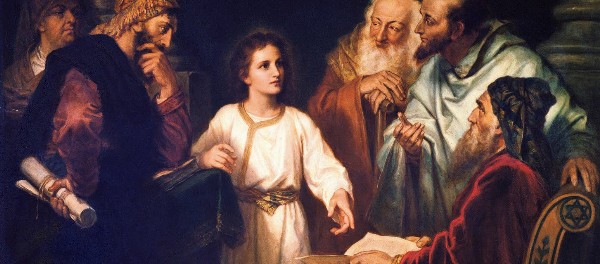
The story of tween Jesus lost in Jerusalem for three days only to be found in discourse with the religious academics poignantly carries the subversion of expectations motif forward. When Mary finds him, she scolds him in the way that most any mother would, “Your father and I have been anxiously searching for you.” And yet, Jesus’ response is perhaps the beginning of the soul-piercing spoken of a few verses earlier, “Didn’t you know I had to be in my Father’s house?” While I don’t think this is an example of Jesus copping a pre-pubescent attitude, the question posed here (as well as the next couple chapters) is “Exactly whose son is this?”

The Gospel of Luke 1:26-80

Ok, now I know why people take years to write commentaries. Because that’s the sort of time it would take to give the attention to the Scriptures that they deserve.

I don’t have that sort of time. Not now, and not in the foreseeable future.

So in order to finish this project in a timely manner (end of summer), we’re going to need to move things along. At least for a while, I’ll be shooting for breadth and not depth.

Luke 1:26-80

The remainder of Luke 1 narrates the angel’s appearance to Mary, Mary’s visit with Elizabeth, Mary’s song, John’s birth, and Zechariah’s song (which will be followed by Jesus’ birth in chapter 2).

You may have noticed them already, but there are some obvious parallels going on with John’s and Jesus’ stories.

Like John’s conception, Jesus’ conception is miraculous, but to an even greater extent. In fact, in some ways, Mary/Jesus’ story is meant to be an intensification, a “one-upping” so to speak, of Zechariah/John’s story.

Mary’s response to the angelic visitation is one of belief and humble obedience, while it seems that Zechariah’s was one of disbelief and doubt.

Mary’s Song comes in advance of Jesus’ birth. While Zecharaiah’s is a response to John’s birth. Of course, you could make a pretty good argument that Zecharaiah couldn’t sing a song because he couldn’t speak at all. Nonetheless.

John’s birth is a fairly short narrative. Jesus’ will occupy all of chapter 2. None of this is meant to diminish who John was as a person, but is perhaps a technique that Luke is employing to highlight the even greater significance of who Jesus is. A point that John himself would make in chapter 3.

The reason I bring all of this up is to help us be continually reminded that Luke is indeed crafting a story. That doesn’t mean that these things didn’t happen. I certainly believe they did. It does mean that Luke isn’t “reporting” events in television reporter kind of way (although, truth be told, television reporters are telling a story, as well). Luke has a mind for sequencing, scene changes, emphasizing certain things, while ignoring others.

And it is a story that has been well thought through. It is a big story that tells the grand narrative of God at work throughout all history, and particularly the promises made to God’s people throughout the ages. However, against the backdrop of this big picture, we have individuals – “little people” – whose own dreams and hopes and actions matter. An old couple who may have longed for children all their lives are visited by God. A young couple of humble means fearful about what the future holds who are entrusted with carrying God’s Son.

God is moving his huge over-arching cosmic purposes forward. But that doesn’t mean that the details of our comparably small and insignificant lives are overlooked in the process. In God, everything matters. Global hunger and our next meal. Ecological meltdown and our very next breath. The witness of the Church universal and my next act of kindness.

And of course, the large and the small are inevitably intertwined.

God’s grand story and our small story? Equally so.

The Gospel of Luke 1:5-25

Most of my ideas on the front end seem like good ones, but in retrospect are often not so hot. I’m not sure how I’m going to get through Luke 4, much less Luke 24. So, here’s the deal, expect average content throughout… less than average for about a month… and then possibly slightly above average towards the end of the summer. Now, with expectations set fairly low, let’s forge ahead.

Luke 1:5-25

Two characters, Zechariah and Elizabeth, are introduced in such a way as to evoke “echoes” of some of the birth miracles of the Old Testament. Abram and Sarai, Jacob and Rachel, Samson to name a few. Aged and childless, they conducted their lives in such a way that they were called “righteous in the sight of God.” They are portrayed as ordinary Jewish people going about their lives. Ordinary people through whom God is going to doing an extraordinary thing. In some ways, this anticipates a recurring theme through Luke (and Acts, and the gospels, and the New Testament in general) that God uses regular people for his purposes. And since their story precedes Jesus’ own miraculous conception, it is a foreshadowing of sorts that God is on the move.

Verse 5 also makes mention of Herod. The Herod’s of the New Testament can be very confusing. This one is not the same one that is encountered later in the gospels. And that’s not the same one that is encountered in Acts. The Herod in verse 5 is the ancient equivalent of George Foreman. Everyone in the whole family is more or less named Herod.

Ok, we’re about done here, but a word about priests. Zechariah would have had normal priestly responsibilities in attending to temple worship. And as Providence would have it, while he is going about his daily priestly routine, he is chosen by lot to be the one who enters the holy place to offer incense. This isn’t to be confused with the Holy of Holies. That would be where the high priest alone could go and only once a year. Still even to be chosen to do what Zechariah was appointed to do that day would have been seen as a special honor.

Like I’ve said, I think the important question to ask is “What did Luke intend to communicate in this passage?” I also think the question, “What did God intend to communicate?” is an important one as well. It could be more than Luke had in mind, but certainly not less.

As best, I can tell Luke is really still setting the stage for what is to come. By highlighting God’s work on behalf of Zechariah and Elizabeth, I think the idea is that more and bigger is to come.