
Miller’s Miles

Blind Pilot – The Story I Heard

I finally got around to reading Donald Miller’s A Million Miles in a Thousand Years. I love his writing. He makes me laugh out loud no matter where I am. With my family at home. Alone in my office. In a crowded coffee shop. Laughter that can’t be restrained. I’ve often noticed how difficult it is to express sarcasm in the written word. He does it effortlessly. He is self-deprecating. Witty. Profound. What’s not to like?

However, despite a deep appreciation for most everything he writes, I resisted picking this one up for a couple reasons. One, I have a psychotic aversion to trendiness. In the space of a week, it had become the thing to read, and for that reason alone, I wanted no part of it. Two, (and I haven’t been able to completely push through this one yet) I have an equal measure of disdain for anything that smacks of “self-actualization.” And the whole “write your own story” premise smacks of Depak Chopra or something along those lines. Again, my problem. Not his.

Finally, curiosity won out. He lives up to usual form – funny and insightful – generally within two breaths of each other. One of the things I appreciate most about his writing is his ability to summarize an idea that he has been exploring in a memorable phrase or two. Here were a few of my favorites…

“The great stories go to those who don’t give in to fear.”

Deep down, we all know this to be true. Too often fear controls us and confines us to living diminished stories. I think this is one reason I enjoy mountain climbing. It allows me a chance to face and overcome fear. And there have been numerous terrifying situations I’ve found myself in. Narrow ledges for walkways. Sheer rock faces. Ridges that fall of thousands of feet on either side. Falling boulders. Loose hand holds. I’ve had to push through being scared plenty of times on mountains. And hopefully, pushing through fear there, helps me to push through other, more everyday fears.

Speaking of mountains…

“The mountains themselves call us into greater stories.”

I think it is common knowledge that there are beach people and mountain people. Suffice it to say, I’m a mountain person. Both mountains and oceans are epic and beautiful, but mountains require something of you. They are wild and unpredictable. In a word, they are exhilarating. I know that the ocean (especially on the open water) can be equally demanding and wild, but I favor what the mountains have to offer.

“He understood the story was not about him, and he cared more about the story than he did about himself.”

In my opinion, this is the single most important sentence in the entire book. It is one that keeps this book from becoming just another exercise in self-absorption. Re-read the sentence and let it sink in.

However, this statement which points away from self and to something larger had a rival for most important. The  contender being…

“The reason Danes are so happy was this: they had low expectations.”

Poignant and classic.

But the phrases that will linger with me the longest are…

“I didn’t want his words to mean anything. I didn’t want to need his affirmation. But part of our selves is spirit, and spirits are thirsty, and my father’s words went into my spirit like water.”

Cover-to-Cover – Week 2

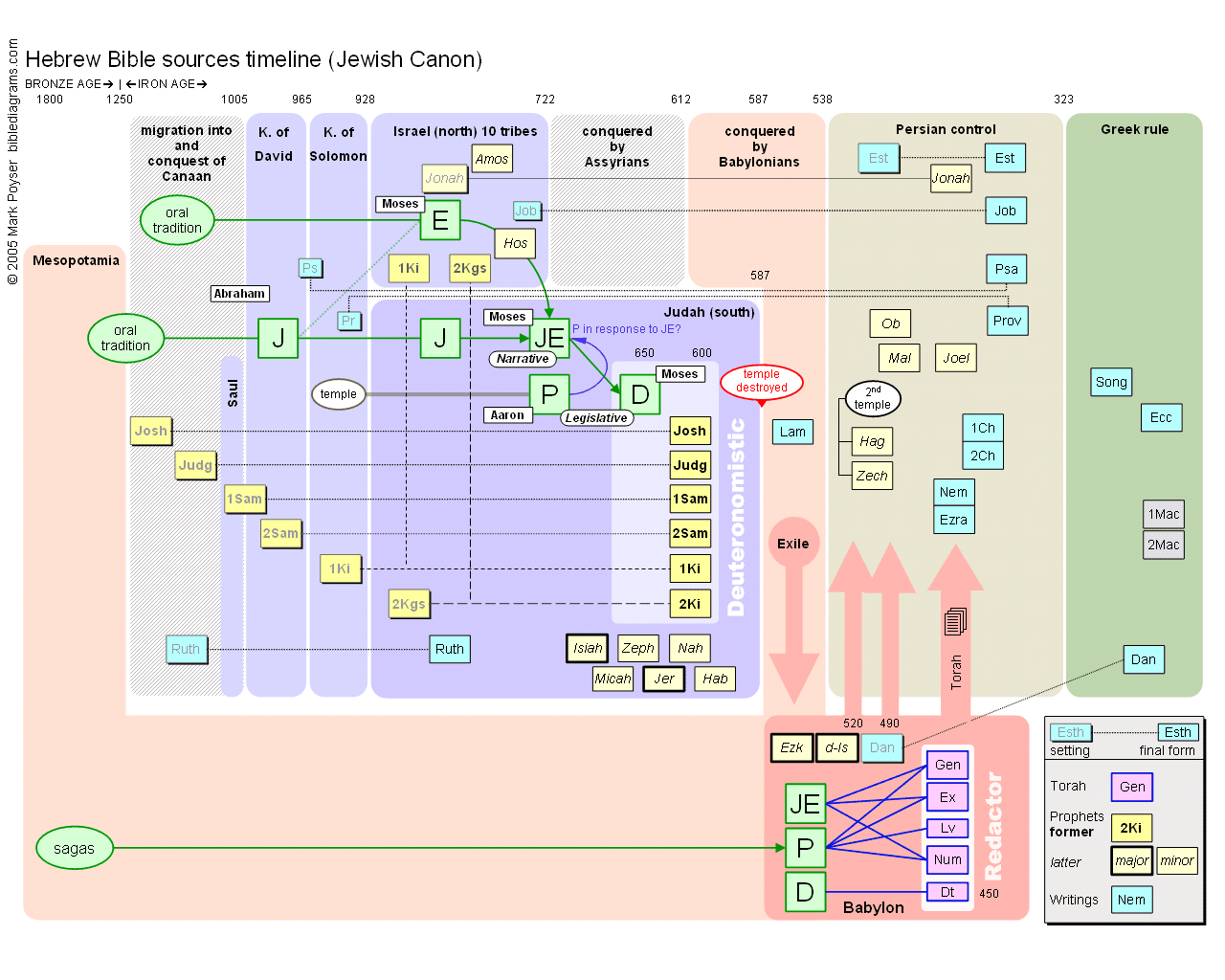
As I’ve been reading along this week, I was reminded of the problem of setting versus date of composition.  Setting being the “when” and “where” the events are taking place.  Date of composition being when the story or book was actually written.  As you might suspect, as with everything Bible, this can be a very complicated issue.  However, the Genesis account will serve well enough to illustrate the difficulty.

Many conservative Biblical scholars would affirm Moses as the author of Genesis.  So, we have Moses writing some stuff down around 15th century B.C.  Of course, this means that Moses wasn’t a first hand eye witness of anything that is recorded in Genesis.  Which raises the question, how did he know?  I suppose there are some who would ascribe to a theory of God supernaturally revealing the info to Moses and he simply dictated what God said.  Most would affirm some sort of oral/written tradition that had been handed down over centuries, and Moses was the one who collected and shaped it into its final form.  Naturally, there are other theories about who wrote what and when.  Some would date the final form of Genesis much, much later.  Closer to 5th or 6th century B.C.

Anyway, all that’s sort of beside the point.  Mainly, I wanted to share a chart that might help you keep track of the flow of the story.  For what it’s worth…

Then, there is this one too.  It is loads of fun.

When Foster speaks…

…people should listen.

Elvis Perkins – While You Were Sleeping

I not only read the Bible.  I also read books about the Bible.  But in ultimate nerd fashion, I also read books about reading the Bible.

And this morning, I came across this quote from Richard Foster’s Life with God: Reading the Bible for Spiritual Transformation:

“In seeking to discover this with-God life it is helpful to read the Bible in four distinct ways.  First, we read the Bible literally.  Reading from cover to cover, internalizing its life-giving message. By reading the whole of Scripture, we begin to apprehend its force and power.  We enter into the original dynamics and drama of Scripture: struggling with Abraham over the offering up of the son of promise…”

It goes on, but the example of Abraham and Isaac is as far as we’ve read so far.  There are three other “distinct ways” to read the Bible, but you’ll need to read the book to get those.

Never fear.  I’m certain that I’ll be sharing other nuggets of wisdom as I come across them.

Cover-to-Cover – Week One

Already a week in, and things have gotten pretty strange.  Let’s catalogue the depravity of humankind so far:

We manage to make it all the way to generation two before cold-blooded murder enters into the picture.  And it is violence at its worst…  religiously motivated violence.  What is Cain upset about?  Abel had an “acceptable” offering and he didn’t.  What a whiner baby.

“Sons of God” (whoever they were) getting with “Daughters of Men” (whoever they were).  Nice.

In fact, things get so bad that we are only six chapters into human history and God has to re-boot the human race with Noah.  Not that Noah and his family are any real prize.  Right after they get off the boat, there is some odd encounter involving Noah in the buff and one of his sons.

Shortly afterward, humankind tries to build a tower to “reach” Heaven.  Some people just don’t get it.

Abra(ha)m (the forefather of three world religions) pawns his wife off not once, but twice as his sister, in order to save his hide.  And technically, it wasn’t a lie.  She was his half-sister.  Its own brand of weirdness.  What’s maybe most troubling is that instead of some negative repercussion, he is “rewarded” with wealth in the form of livestock and money and slaves (?!?).

But all Abraham’s pathetic-ness doesn’t begin to touch that of his nephew Lot and his family.  Of course, the big clue is that Lot takes up residence in Sodom…  the ancient equivalent of Las Vegas, Amsterdam, and Bangkok all rolled up into one.  So when two angels come to “visit” Lot there, the citizens of Sodom come to his house to have “relations” with his house guests.  Lot’s brilliant solution?  Offer up his daughters to the crowd instead.

Speaking of his daughters…  one’s at a loss of words to know what to say about the whole incident with between them and Lot in the cave.  I mean really?  Lot was completely oblivious?  Really?  Just sick…  and coming from someone who lives in Arkansas, that says a lot.

It sort of seems like the writer of Genesis is going out of his or her way to say, “look at humanity at its most messed up, most broken, most depraved.”  This is the sort of stuff we would expect for soap operas, not God’s “chosen” people.  I find it interesting that the writer never says, “and they were very wicked” or “in doing this they sinned against the Lord.”  There is a remarkable silence when it comes to the behavior of these earliest biblical characters.  It is as if the writer is attempting to draw our attention to a much larger, grander story than the failings (no matter how spectacular) of these biblical characters.

In fact, perhaps the single most helpful thing to bear in mind during this year-long project is that the main character of the Bible is God…  not us.  And if we listen attentively to these early chapters of human history with this truth in mind, the tune we begin to hear is that God is faithful.  And He is good.  Even when we are not.

Tim Keller on Genesis 1 and Evolution

I know that the Genesis 1-3 reading was a couple days ago, but I stumbled across this paper that Tim Keller wrote to address several of the questions that are raised concerning Genesis 1.

He has written a few books that have been very well received, The Reason for God, The Prodigal God, and Counterfeit Gods. And from what can be gleaned by reading Deep Church, his ministry in New York exercises a considerable influence on Belcher and others like him.

In this paper, he addresses the following three questions:

Question #1: If God used evolution to create, then we can’t take Genesis 1 literally, and if we can’t do that, why take any other part of the Bible literally?

Question#2: If biological evolution is true—does that mean that we are just animals driven by our genes, and everything about us can be explained by natural selection?

Question #3: If biological evolution is true and there was no historical Adam and Eve how can we know where sin and suffering came from?

His answers are well worth reading.

Three Books from 2009

Ok, I read a few books last year.  I’d like to share three.  They weren’t published last year, but that’s when I read (or re-read) them.  You would be doing yourself a favor to get your hands on any of them.

This is one is sort of a no-brainer.  If you only read one book this year, it should probably be this one.  In many respects, this is Wright at his finest.  He is a book writing machine.  Some of them very academic.  Others far less so.  I’d say this is written for something of a broader audience, but it ain’t no Joel Osteen, if you get my drift.  Here, he presents as robust a vision of resurrection life.  And who doesn’t need that?  Thought so.

I had the pleasure of re-reading this book this year and was reminded how good it is.  It is not difficult to read, and it helps people get a grasp on understanding how to interpret Scripture.  It is the difference between giving a man a fish, and teaching him how to fish.  The latter being obviously infinitely more valuable.  One person who read this with me said that she thought every Christian should read it…  and I couldn’t disagree.

This one may come as something of a surprise, but man, that J. K. can weave a tale.  Sometime in 2009, shortly after number six came out in the theaters, I got started on the series.    They are all enjoyable, but this one seems to be the best of the ones I’ve read so far.

I know that there are those who have sizable misgivings about the Potter series.  I share some concerns, but it isn’t the outright witchcraft that bothers me.  Things like mistrust for the “Ministry” and episodes of cutting loom larger in my mind.  And yet, occasionally you can come across some stuff that is about as solid as it comes…

“I do not think [Voldemort] understands why, Harry, but then, he was in such a hurry to mutilate his own soul, he never paused to understand the incomparable power of a soul that is untarnished and whole.”

Albus Dumbledore from Harry Potter and the Half-Blood Prince

I can scarcely think of a more fitting description of the damage we do to ourselves when we choose to live life other than the way it was intended to be lived.

Naturally, in order to appreciate number five, you’ll need to get after the four that lead up to it.  The one thing that is both genius and diabolical (but in a good way) is that you can’t really be in for just one.  As soon as you read the first twenty pages of Sorcerer’s Stone, you are in for the loooonng haul.

Alright, times a wasting.  Get on it.

In the beginning…

Andrew Bird – Ten-You-Us

I love “beginnings.”  And today we have a few.

The first is the beginning of a new year.  2010.  I seem to remember a science-fiction movie from the ‘80s bearing this year as a title.  I’m going to have to go back and re-watch it to see how much they got right.  My guess is not much.

It is customary to make resolutions as the new year begins.  I’ve certainly made more than a few in past years.  Nothing against them.  However, as I get older, I find myself more and more hesitant to make them.  My life is already littered with enough unfinished stuff that I don’t really have any business making any grand new promises that I may or may not be able to keep.

Save one.  I mentioned it a few days ago, but let me say it again if only to remind myself.

Today, I’m beginning to read the Bible from cover to cover.

I do, in fact, hope to accomplish one or two other things this year, but this is the one.

Part of me wants to attack it Harry Potter-style.  That is to tear through it in as rapidly as possible so that I can say, “Ok, done. What’s next?”  But that would defeat the purpose of taking on the project in the first place.  My hope in doing this is manifold, but mainly, I want to know the Author more.  So instead, I’ll be taking it at much more reasonable pace, a few chapters a day.

Which brings me to the most famous of “beginnings”…  Genesis 1:1.

It would be hard to guess how much ink has been spilled on the first three chapters of Genesis, but it is considerable.  Instead of my own commentary, let me point to another.

John Walton recently wrote a book on Genesis One.  I haven’t read it, but I’m very familiar with where he is coming from and would commend this book to anyone who would like to have their understanding of the biblical view of origins stretched.

He says, “We should not expect the Bible to answer the questions that arise from our own time and culture.  Genesis was written to Israelites and addressed human origins in light of the questions they would have had.  We should not try to make modern science out of the information that we are given, but should try to understand the affirmations that the text is making in its own context.”

Well said.

Ok, well I have high hopes for 2010 being an amazing year in all kinds of ways, and I trust that reading the entirety of the Scriptures will play no minor role in that being that case.

Done with Deep Church

Week after week, they heard the gospel preached from the Old Testament to the New Testament.  As Doug said, “It began to change the way we thought about all areas of life.  We realized the gospel impacted every aspect of our lives.  Our lives took new meaning.  It was and is exciting.”

Great ending to the book.  While not necessarily encountering much that I haven’t already been exposed to or thought through, I do so appreciate Belcher’s efforts to bring unity to what is increasing becoming a factionalized evangelical church.  Some of my criticisms still stand.  I still think this is largely a young-ish American white middle to upper-middle class conversation.  I’m just not sure how much people who fall outside this demographic really care about the sorts of things being discussed here.  That said, he is communicating my own feelings about what the ideal church looks like.  In short, I think Jim and I could hang together.

However, I’d like to take this opportunity to focus in on the last eight words of the first sentence of the quote above:  “from the Old Testament to the New Testament.” It is no secret that the Old Testament is massively neglected in most churches, and for that reason, most church attender’s lives.  And yet, I love what is being affirmed here:  The gospel shines through the whole of Scriptures, and not just the relatively small portion towards the end.

Starting January 1, I’m embarking on a new reading project…  the Bible.  All of it.  In a year.  Crazy, I know.

Trust me, I realize that that isn’t really much all that revolutionary about doing this.  I’m confident that there are millions of people who read their Bible all the way through every year.  J. I. Packer is famously quoted as saying, “Every Christian worth his (or her) salt reads the Bible cover-to-cover every year.”

While it won’t be the first time I’ve read the Bible all the way through, it will be the first time a several years that I’ve done so.  Part of what drew me to the project wasn’t just the my personal sense of needing to do so, but to do so with others.  So, I’ll have several friends doing it with me.  Men that I meet with on a weekly basis.  Students with whom I do the same.  Probably some co-workers.  Other people from church.  You know, some of the same folks who just attempted to finish Deep Church.

I’ve been asked by at least one person to consider blogging the entire project.  I’m not making any commitments yet, but I will ponder it the next few days.  So much I’d like to say, and so little time to do so.

By the way, if either of you who read this blog are interested in joining in on the Bible reading plan, I’ll be following this plan from Bible Gateway.

Deep Church 10

Loved this quote towards the end of the chapter where he tells the story of a member in his congregation as an individual who embraces this vision.  He happens to be the mayor of Anaheim, and he is seeking to restore a sense of beauty, vitality and community to the city’s downtown.

Using the principles of the free market, he convinced the city to rezone the light-industrial area around Angel Stadium to create a city center filled with apartments, shops, boulevards, cafes and offices.  Anaheim, like many suburbs in California in the 1960s and 1970s, wiped out its historic downtown, replacing it with strip malls and parking lots.  The city and its community have suffered ever sinc …  [The mayor] wants to reverse this trend and bring back a thriving downtown, which will bring back residents and a strong sense of community.  He is promoting the shalom of the city.

So once again, we return to this idea of salvation being more than just an individual’s personal experience with God.  As important as that might be, it is too small a salvation for what God envisions. 

I especially appreciated this example, because of an interest I have in community and dwellings places that promote that.  Just received an unexpected gift this Christmas that explores this whole idea even more, The Architecture of Community by Leon Krier.

Shalom out.

Deep Church 9

Jeremy Larson – Purgatory

Let’s try to make this short and sweet.  Big words like “ecclesiology” have a way of turning people off.  And the church has often turned people off.  And talking about the church can do the same.

I share Belcher’s opinion that neither the emerging church (or churches trying out new forms of church) nor the traditional churches have a rich enough appreciation for what it means to be the church.  However, I think the conversation needs to move away from simply talking about structure or praxis and towards ontology.  Or in other words…  what does it mean to be the church?

Not that churches don’t need to be challenged to re-look the way they approach their life together as a church.  They should.  In my opinion churches need to be constantly reminded that they don’t exist simply for themselves as an institution.  That they move from an inward focus to an outward one.  The ways we approach evangelism or church discipline or discipleship or any other host of issues need to be examined and when necessary adapted.  However, those things don’t necessarily define what a church is.  They are what we do; not who we are.  And although sometimes mistaken for the same thing, it isn’t.

A few years ago, the church I’m involved in re-looked at who we were and who we were hoping to become, and here’s the statement we came up with…

We exist to mobilize a racially-unified family of God, called out as the presence of Jesus in our world, to pursue His mission: all people reconciled to God.

Now, I realize that even this well-thought through statement doesn’t plumb the depths of what it means to be the church.  And while there might be a word or two that I’d go back and change, there is so much that I appreciate about it.  Each phrase matters.  All the important pieces are there.  It is a good length.

But most importantly it is right, and I have the sense that those of us who are most deeply invested in our local body believe it is right.  It is a statement about who we are (becoming) as a church.  And it is one that actually guides our practice and to a certain extent our structures.

This is going to sound a bit trivial, but… I love this church.  I really do.

It isn’t perfect.  Nor are we pretending to be.

Ok, so much for short.  But it is sort of sweet.