
Three Views Revisited

Julie Peel – Unfold

A few days ago, I mentioned that I was reading a book entitled Three Views on the New Testament Use of the Old.  I’m done now and wanted to make some reflections on the book and subject.  So be forewarned…  boring theology talk is about to commence.  I use this blog for a variety of purposes, one of which is to think out loud.  Therefore, you may want to simply click ‘play’ on the song above and enjoy a little background music while you go do something else on the internets.
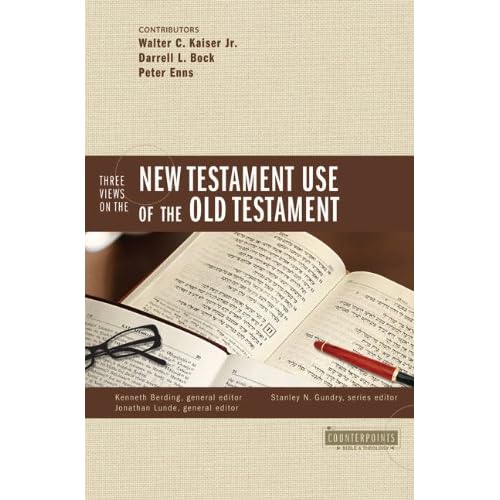
First, a few preliminary comments on the strategy of the book.  It is a part of a series called Counterpoints which covers a wide variety of topics, including the Rapture, hell, women in ministry, baptism, and so on.  The general layout of this series is that an editor will make some introductory comments, and then the various proponents of whatever view will sound off.  After each view is presented, the other contributors have a few pages to respond to the main essay.  The other day, I called it a theological cage match, but that wasn’t entirely fair.  It really has the tone more of a cordial debate than a smack down.

The contributors for this particular volume are well known biblical scholars in the evangelical academic community: Walter Kaiser, Darrell Bock, and Peter Enns.  The volume editor, Johnathan Lunde, makes some very helpful introductory comments on the subject of NT/OT intertextuality which provide even the uninitiated with some handles to begin to grasp the major contours of the lay of the land.

And it is very unfamiliar territory indeed.  Sometimes it is easy to forget that the New Testament is inextricably linked to the Old.  For example, you can buy a New Testament that is unencumbered with all that lengthy prolegomena.  A not so subtle suggestion that we don’t really need to know what is in the Old Testament, just the bits that involve Jesus and everything after that.  Frankly, its a bit offensive.  Can you imagine if they sold an Old Testament only version of the Bible?  Funny to think that was all Jesus, Paul, and the gang had to work with.  And yet, even a casual reading of the New Testament reveals its dependence on the Old Testament both for its major themes and frequently for exact wording.  Ok, nothing really debate worthy there.

However, if one puts those references and quotations under greater scrutiny, a problem emerges.  Sometimes, it looks as if the New Testament author hasn’t really understood the Old Testament passage correctly or has taken something out of context, and in doing so has imported a meaning onto the text that wasn’t there in the original Old Testament author’s mind.

The classic example is in Matthew 2:15, where he quotes Hosea 11:1 – “Out of Egypt, I have called my son.”  In Matthew, the verse is cited as being somehow prophetic with respect to the journey that Jesus’ family makes to and from Egypt early in his childhood.  Now, if one just sort of blows through Matthew without pausing for much reflection, the reader is unaware of any “foul play.”  However, when one goes back to Hosea, it seems (to some) that the text doesn’t seem prophetic at all, but is instead a look back at God’s saving act in history – specifically the deliverance of Israel from Egypt under Moses’ leadership.  In this context, it is relatively clear that Israel is the “son.”

So there is a tension there…  Is Matthew playing fast and loose with the text?  Is he a poor exegete and misunderstood what Hosea has said?  How one resolves this “tension” is largely shaped by certain understandings of how the New Testament authors approach the Old.  Kaiser (and those sympathetic with his view) doesn’t see the possibility of two different meanings for a single text.  Rather, the Old Testament author had an intended meaning and whatever the New Testament author is doing must agree.  So for example, Kaiser would likely argue that the Hosea text was in fact predictive and that the “son” there looked forward to Jesus in some way and that Hosea would have been conscious of the predictive element in his writing.

Bock represents a fairly nuanced view that sees patterns in biblical history.  So, he wouldn’t necessarily need to argue that Hosea was predictive in a strict sense.  However, due to God’s consistent patterns of deliverance throughout history, Matthew is capitalizing on or evoking a theme of deliverance that up until Jesus was most clearly expressed in the exodus tradition.  It is more complex than that, but this sort of approach both recognizes the tension and assumes the best about Matthew in his use of the Old Testament.

The final view that is articulated by Enns is that Matthew is simply employing exegetical practices common to that  time that paid more attention to specific words and how they could be mined for meaning apart from the actual original context.  While this lack of regard for original context might cause concern to the modern reader, Enns would argue that we shouldn’t expect ancient interpreters to conform to modern hermeneutical practices.  God’s Word was spoken into a certain places and times and bears all the marks (including the “faulty” interpretive traditions) of that culture.

Ok, as you might guess, it is far more complicated than that, but that’s why these guys wrote a book, not a blog post.  If you are still reading (and that’s a big ‘IF’), rest assured that all of the positions have merit and can be held by intelligent faithful readers of the Bible.  However, my own view is something of a combination of Bock and Enns.  I appreciate Enns’ observation that the Bible will inevitably reflect the culture in which it was forged.  And yet, I also would affirm that due to its dual authorship (man AND God), that it can transcend culture and take in the grand sweep of redemptive history.

Despite the differences of opinion, one thing that everyone agrees on is that the New Testament’s interpretation of the Old Testament has been indelibly marked by the one we know as Jesus of Nazareth.  After Christ, everything written in the Old Testament had to be re-looked in the light of Christ’s coming, living, dying, and rising.  May our own interpretation of Scripture – both “Old” and “New” – reflect the same.

the bluff

Crazy, I know!  Two posts in one day.  Maybe I do have a blog.

Highlights from the most recent trip to Castle Bluff with high school students.  Enjoy!

currently reading

The Avett Brothers – Ten Thousand Words

I consider myself to be an average reader.  I read more books than some and less than others.  The ones that I tend to gravitate towards usually have something to do with God, the church, theology and sometimes all the above.  Right now, I’m in the middle of four books and each one is a worthwhile read.  So I thought I would share them with you.

The Case for Faith by Lee Strobel is one that I am reading with students.  It is basically a straight forward apologetic for the Christian faith, but written in a slightly more engaging style than your average apologetics.  Strobel (a former journalist) takes to the road and interviews various experts on the big objections people have to Christianity.  So it has the feel of a narrative while providing some solid answers to questions.  Over time, I’ve been less and less compelled by the modernist approach to defending the faith (I tend to see apologetics as being more helpful for the already convinced than the skeptic), but there are some worthwhile observations here.  What I’ve loved most is that the students (and not a few adults) seem to be really engaged by it.  If you need a reminder that Christian faith actually stands up to reason, then you might find this relatively easy read helpful.

I meet with a group of men on Monday mornings, and the book we are wading through right now is a collaboration between Richard Foster and Gayle Beebe entitled Longing for God: Seven Paths of Christian Devotion.  This one was something of a surprise.  Judging both by the cover (which of course we should never do) and by the title, I was thinking this was going to be of the more “touchy-feely” variety.  Well, it’s not.  The strategy of the book is to look back on the history of the church and highlight the contributions various saints have made to Christian spirituality.  It is something of a unique book in that it doesn’t read like a popular treatment of these men and women, nor it read like a college text.  It finds the happy middle-ground of helpful summary, critique, and application.  If you find yourself woefully ignorant of the major figures in church history (and let’s be honest, most of us are), then this serves as a wonderful introduction to and distillation of their thought and practice.

N. T. Wright is a name that I’ve mentioned maybe once or a hundred times around here.  By all accounts, Wright is one of the most influential New Testament scholars alive today.  He is strongest when he is shedding light on first-century Jewish beliefs and practices and how that impacts our understanding of Jesus and the communities from which the New Testament emerged.  He is about half way through an extraordinarily ambitious multi-volume New Testament theology.  However, one of the things I appreciate about Wright is that he takes nearly all of his scholarly work and attempts to make it accessible to a broader audience.  Such is the case with Surprised by Hope.  It is a more readable version of The Resurrection of the Son of God in which Wright ever so slowly wades through what the New Testament teaches about life after death, life after life after death, and so on.  Not the first book I would pick up by Wright, but it wouldn’t be the worst introduction to his thinking either.

This one is called Three Views on the New Testament Use of the Old Testament, and to borrow a phrase from the students I work with “that’s my jam.”  This book is one of a series of books in the Counterpoints Series.  The idea is simple enough.  Take a biblical subject that has a variety of views (and what biblical subject doesn’t?) and let a leading proponent of each view take a whack at it – and then a whack at each other.  It is as close as one comes to a theological cage match.  Anyway, the Old Testament in the New is something with which I have more than a passing familiarity, and this volume lays out the issues and the options with great clarity.  On a side note, I realize that this topic is probably intensely boring to 99.99% of Christ-followers, but I could make a pretty strong case for it being one of the key building blocks for our understanding of what the Scriptures are and the authority they are supposed to have in our lives.

Alright, so there it is.  If you have read or later read any of these books, I would love to hear your thoughts about them.

Back to the Bible (pt. 2)

J. Tillman – Earthly Bodies

If you remain unconvinced that we have adopted the democratic approach to our study of the Bible, just attend most any small group “Bible study” and try this out for a change. When someone starts airing their random reflections on what a particular passage of Scripture means, and they are not quite getting it right, throw this comment into the mix, “I’m sorry that’s wrong. There is no world in which any semi-normal reading of those verses could have possibly meant what you just said. In fact, that may very well be the worst butchering of any biblical passage I’ve ever heard.” What do you think? I’m thinking you have just been de-invited from the group.

No, instead what we tell ourselves and one another is that your opinion is as valid as the next guy or gal’s. So just nod your head. Maybe look a little perplexed, and say “ok, who’s next?”

With most areas of knowledge, we recognize that some people’s opinions count more than others. If I am having a medical problem, I don’t consult with a doctor only to say, “I’m going to get a second opinion from my hairdresser and a third from my stock broker.” And yet, American evangelicalism has unknowingly propagated a way of interpreting Scripture that tacitly implies that everyone’s opinion of what the Bible says is equally valid.

There is a meaning, and (get ready for this) some readings get closer to that meaning (i.e. are more right) than others.

However, I’m not suggesting that we all climb into our little ivory towers and study the Bible. Despite what I’ve said, I really do believe we need each other to understand the Bible. Solo scriptura means “Scripture alone” not “alone with Scripture.”

It is when we are reading with others, and being taught by others, and questioned by others, and challenged by still others, that we find our horizons expanded on what the text might actually mean. Reading in community forces us to confront our own biases and warped ways of looking at reality (and the Bible). Reading in community keeps us from simply assuming that “I” will always have it right.

And not just the “community” of the few other people who are slight variations of ourselves. If I read the Bible with people who are more or less just like me, then I shouldn’t be surprised if all that ends up happening is that we mutually affirm one another’s opinions.

The community includes people of different denominations (even non-Evangelicals). Different races. Different countries. Different time periods. Different education levels. Different ages. As a side note, this is why books are so important… it would be borderline impossible to assemble a group with that range of diversity in one room to study the Word together on a consistent basis. Plus, if it is in a book, the odds go up (sometimes only slightly) that they know what they are talking about.

I realize that this looks like I’m contradicting myself, and in some ways affirming the “we-all-have-something-to-contribute” way of thinking is maybe only a slight variation on Western society’s democratic individualism, but it is that with a twist.

What I’m advocating for is a move away from simplistic readings of Scripture that assume the “I” will always be right in my opinion. The reality is I need help to understand it, certainly from the Holy Spirit, but also from others.

If you are still reading (and that’s a big ‘if’), then I’m guessing only one half of this post resonated with you. If you liked the first half about some opinions mattering more than others, you probably need to go back and read the second half again. And vice versa, if the stuff about reading in community was more up your alley, you should go back and read the first half again. If you liked it all, then you are approaching something akin to Zen-Buddhist enlightenment.

I don’t think there is a fourth option… is there? Oh, yes. I suppose there is the possibility that you didn’t give a rip about any of it. In which case, you should probably just go back to watching re-runs of The Bachelor.

Back to the Bible (pt. 1)

AA Bondy – When the Devil’s Loose

I would have liked to return to the topic of biblical interpretation sooner, but there was this thing called “The Entire Summer” that got in the way.  So, I’m back.

That is back to the Bible.   I closed out last time with the idea that interpretation done on our own will always lead to error.  This isn’t the time or place to go into great detail about how we arrived at a place where the ideal Christian is one who reads the Bible by themselves for hours on end, but maybe the broad strokes will suffice.

I know it is hard to believe but the idea of the “self” that is separated from the rest of one’s society, clan, tribe, family, etc…  is a relatively “new” idea.  Certainly, roots of individualism can be traced back to the 14th century when a person’s capacity to think and reason for one’s self was highly esteemed and praised.  Even in Martin Luther’s famous phrase, solo Scriptura (Scripture alone), we find not only the singular importance of Scripture idealized, but it also implicitly idealizes the ability of the one who is reading the Scriptures… solo.

Well, what got started in the Europe in the 14th century certainly has reached its fullest expression in 21st century America.  The idea that the ‘self’ or ‘individual’ is the most important determinant of what is right and true simply goes unchallenged.  It is one of the givens by which we operate.  When I say it is a ‘given,’ it is just that.

“We hold these truths to be self-evident (that is… not needing any justification), that all men (we’ll assume for the moment they meant women and non-whites too, even though they probably didn’t) are created equal, that they are endowed by their creator with certain inalienable rights, that among these are Life, Liberty, and the pursuit of Happiness.

To be an American is to recognize that that the self is entitled to certain things and has the ability to secure them.  Of course, this democratic way of looking at things colors all we do.  Take for example American Idol (it all comes back to AI eventually).  Regardless of what one thought of the abilities of the contestants, skill or ability was secondary to how much people liked the contestant.  So, if one had the right look (and in our society, maybe every society, the right “look” often determines how much one “likes” someone) then he or she has a decent chance to go far.  Because in the end, it is me the individual, the solo viewer, who has the power to determine what ‘good’ is.

Stick with me, this is going somewhere.  If the individual, the solo viewer determines what talent is or isn’t.  Then it really isn’t that much of a jump to get to a place where it is the individual, the solo reader who determines what is right or true when interacting with Scripture.

to be continued…

myTunes

Before I attempt resuming something akin to regular posting, I’m easing back into blog-world by simply updating you on what has been the soundtrack to my life over the past couple few months.  Here goes!

Andrew Bird – Fitz and the Dizzyspells EP

This one has been on such heavy rotation at the house that I’ve made everyone sick of it… including myself.  But it is just that good.  It is a collection of songs that eventually ended up on his latest full-length Noble Beast, but these are snapshots of those songs in earlier development.  And in my opinion, these versions are the better ones.

Andrew Bird – See the Enemy

Phoenix – Wolfgang Amadeus Phoenix

I was first introduced to Phoenix a couple years ago by a friend.  I think they had some songs on the Napoleon Dynamite soundtrack.  I liked it, but thought it was a little quirky… both the movie and the band.  Anyway, with the release of Wolfgang Amadeus Phoenix, this French band manages to retain some quirkiness, while producing interesting music.  I don’t watch TV, but I hear that they have had a good bit of exposure there.

Phoenix – Armistice

The Welcome Wagon – Welcome to the Welcome Wagon

On first listen, I thought it was Sufjan Stevens playing a trick by releasing a new album under a different moniker.  And yet no…  the wait for another release from the indie music poster child continues.  While not sharing the same voice, they do share the same label.  Religious messages conveyed in music that doesn’t sound churchy?  I’m in.

The Welcome Wagon – He Never Said a Mumblin’ Word

We Were Promised Jetpacks – These Four Walls

Judging from the thick brogue, these folks hail from the land of bagpipes and kilts.  I’m guessing they employ neither.

We Were Promised Jetpacks – It’s Thunder and It’s Lightning

Passion Pit – Manners

Their meteoric rise to popularity is problematic for me, because it makes me look like every other musical fad following wannabe.  But it is good, so they make the cut.

Passion Pit – The Reeling

Blitzen Trapper – Black River Killer

This is the most recent addition to my fall line-up.  I was first turned on to this band when I heard their song, Furr.  I liked them enough to include on last year’s “Best of.”  And the more I find out, the more I have reason to like.  They’re from the Pacific Northwest… Portland to be exact.  And like all great indie band/musicians from that area, they are on SubPop’s label.  You are getting to sample the title track here.

Blitzen Trapper – Black River Killer

Ok, there are others that could be mentioned, but these are the highlights.  Let the listening enjoyment begin!

nothing to see here… move along

Do you remember that time when I sort of used to have a blog?  Yeah, me too.

There was even a brief stretch when I posted EVERY day.

This summer has been loaded with adventures, yet nary a word about it here.  Pathetic.

In a week or so, I plan on actually resuming more regular postings.

Until then…  move along.

piper on tv

Sometimes, John Piper will say things that leave me scratching my head in bewilderment, and other times I feel like he and I could have been college roommates.

This post on TV would be evidence of the latter.  The whole thing is worth reading (even if I don’t agree with every word), but the section found below could have been titled “Taido on TV.”

But leave sex aside (as if that were possible for fifteen minutes on TV). It’s the unremitting triviality that makes television so deadly. What we desperately need is help to enlarge our capacities to be moved by the immeasurable glories of Christ. Television takes us almost constantly in the opposite direction, lowering, shrinking, and deadening our capacities for worshiping Christ.

Not to put words in his mouth, but what I think Piper means is that television glorifies the trivial and in doing so simultaneously diminishes that which is truly significant.

BTW, for two-more-cents on media, here’s what my missionary friend in Florida shared today.

Which reminds me…  I saw the second installment of Transformers last night.  I should have known, but it was extraordinarily stupid.  Don’t get me wrong, I loved seeing some Optimus Prime go nuts on the entire Deceptacon army, but the whole movie could have been forty-five minutes shorter had they cut out the decidedly uninteresting “love” story.  I literally laughed at the climactic moment when the leads exchanged their heartfelt expressions of love.  It was a joke, which would explain why I thought it was funny.  But I certainly knew what I was in for…  a movie that would be high on entertainment and completely devoid of substance.

I realize that I’m both knocking media and extolling its cheap-entertainment value in the same post.  And so, the tension that characterizes so many areas of my life persists.  Like the tension I’m feeling right now that I really should be working on promised posts about how we read the Bible.

How do I live with myself?

d-camp

Each summer, we take our middle school students for several days away from the comforts of home and civilization to something simply known as D-Camp.  The vision is simple enough…  spend several days challenging students in all sorts of ways.  They are pushed to overcome certain fears…  fear of heights, fear of not being in control, fear of bugs, fear of dirt, fear of water; and instead learn to trust…  trust ropes, trust people holding ropes, trust people standing on ladders.

Of course, the same challenges are faced in relationships, as well.  There is the fear of betrayal, fear of rejection, fear of not fitting in, fear of being made fun of.  But slowly (sometimes, very slowly) that is transformed into trusting others… leaders, peers, work crew, camp speakers, worship leaders, etc…

But the ultimate hope is that in the challenge to face fears and embrace trust that the same thing might happen spiritually.  That middle school students will push through the obstacles keeping them from living lives devoted to Christ (and they are many), and instead choose to trust in the One who is entirely trustworthy.

Here’s the week captured in photos and condensed into ten-minutes:


not so far fetched

Working with students, I find myself occasionally in conversations like this.  BTW, at least one of the questions posed is being argued even today among “grown” people.  I’ll let you decide which it is.